
Dmitry Akselrod
Мне тут сообщили, что надо больше писать малоизвестные (за пределами Израиля) факты о конфликте.
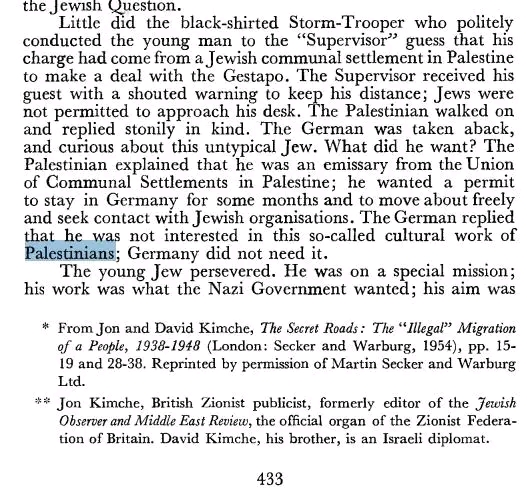
Ок, один такой факт: в антологии историка Валида Халиди от 1971 года, посвящённой разоблачению сионизма и обоснованию арабских прав на Палестину, которая стала одной из священных книг для всех его идейных последователей (например, Илана Паппе), почти тысяча страниц.
На них 17 раз встречается словосочетание Palestinian Arabs;
26 раз - Palestinian Arab;
Более 1200 слово Arab, более 700 - Arabs, в большинстве случаев относящееся к арабскому населению Палестины;
И... 18 раз слово Palestinians, несколько раз относящееся при этом к евреям (и чуть ли не в половине случаев использующееся в духе "в 1948-м воевало столько-то арабов, из них столько-то палестинцев"; т.е., обозначающее группу населения не как что-то отдельное, а в смысле "в отряде было столько-то русских, из них столько-то москвичей").
В противоположность одному из основоположников палестинского национализма (в его защиту надо заметить, что он ещё не знал, что надо писать "палестинцы", и честно писал так, как люди себя реально называли - арабы), для современных авторов слово "арабы" применительно к соответствующей группе - табу и практически святотатство.
Ну и вернейший способ прослыть сионистским агентом, распространяющим апартеидную пропаганду, конечно.
![his discoveries was that the "economic absorptive capacity"] criterion for immigration ignored fundamental political and The editor still recalls the breathless incredulity, with which he, as a boy, first saw the proposed map (Map 7, p. 337).* Ever since 1917 the Arabs had been saying that the "Jewish national home" was merely a euphemism for a Jewish state, only to be referred by London to the "safeguard" clause in Article 2 of the Mandate about "self-governing institutions". The Arabs, of course, were horrified at the very principle of partition, which they saw as the vivisection of their country. But they were equally horrified at its interpretation which gave the Jews 40% of Palestine at a time when their land ownership did not exceed 5.6%. The envisaged Jewish state included hundreds of Arab villages and the solid Arab bloc of Galilee north of Nazareth (Maps: 1, p. 94; 13, p. 672; and 14, p. 673). But the cruellest provision of all was that there should be, if necessary, "a forcible transfer of Arabs" from Arab lands allotted to the Jewish state. This was, indeed, a nightmare come true. The partition proposals served only to fan the flames of Arab rebellion. In Chapter 33 Barbour traces the "Dark Path of Repression" followed by the British. Chapters 34-36 and Chapter 39 afford us glimpses of some of the techniques used: the blowing-up of residential quarters in Jaffa in 1936, in the name of "town planning", fearlessly condemned by McDonell and Manning, the British judges of the Palestine High Court (Chapter 34); the eye-witness account by Kirkbride, District Commissioner, of three Arabs hanged in Acre Prison early one morning in the spring of 1937, (Chapter 35); the "environmental punishment" visited on the Arabs of Mount Carmel in 1936-38 described by Newton (Chapter 36); and the terrorisation and murder of Arab villagers by special British-trained Jewish squads (in which Moshe Dayan was recruited) in 1938, in the account by Mosley (Chapter 39). In Appendix IV (p. 846 ff), the editor conservatively estimates Arab casualties during 1936-39 at about 5,000 killed and 15,000 wounded, out of a population of one million Arabs. Translated into British and American figures (populations 40 million and 200 million respectively)](https://media-moera-blog.s3.amazonaws.com/IOEykrXn9qc1wDgmjKJb3fjGo0o_1710651970.jpg?response-cache-control=private%2C%20max-age%3D259200&X-Amz-Algorithm=AWS4-HMAC-SHA256&X-Amz-Date=20260929T094119Z&X-Amz-SignedHeaders=host&X-Amz-Credential=AKIAW3MEBNDN4PRSIX5F%2F20260929%2Fus-east-1%2Fs3%2Faws4_request&X-Amz-Expires=259200&X-Amz-Signature=3a62d38c884e680bb742088745f019285b729f2522c663226eb715149278e449)